Showing posts with label Indian Sculpture. Show all posts

Tuesday, May 5, 2020

Conch Shell Ganesha

A patron recently commissioned a large portrait of a tiny Ganesha figurine. The unusual sculpture was made to look as if it were assembled of conch shells. The conch is a predatory sea snail found in the Indian Ocean. The Shankha, a conch shell used as a trumpet in Hindu ritual, is praised as a giver of prosperity, longevity, and fame, and is an emblem of the Hindu preserver god Vishnu


Detail of Shanka Ganesha


The painting would be a surprise birthday gift for the man's wife who is especially fond of the little Ganesh statue that holds significance for their family. Lord Ganesha, one of the most worshipped deities in the Hindu pantheon, is the deva of intellect and wisdom. Widely revered as the remover of obstacles,  elephant-headed Ganesh is honored at the start of rites and ceremonies.


Together we selected a beautiful Indian hand-blocked cotton Kalamkari fabric printed with natural vegetable dye to use as the canvas. The fabric design features a large circular mandala with delicate floral and paisley designs. The circular motif would frame the icon like a halo and add another large element to the composition.


Because the painting will be hung on dowels as a scroll, acrylic paint was chosen for its flexibility. The paint will not crack when the scroll is rolled. Another benefit of acrylic here is that it can be used on unprimed cotton canvas without causing the fabric to rot as oil paint would.


Making the uniform brown color of the statue interesting would be a challenge. Another concern was how to incorporate it into a fabric which did not contain brown colors. Using mostly metallic colors, I built up transparent layers of paint which allow the fabric's pattern to show through. This adds depth, complexity, and gives the richness of an aged patina.


A detail of the face (above) shows a good example of the kinds of coincidental occurrences I find fascinating while I paint. Placement of forms often coincide or mirror similar shapes in the pattern of the underlying fabric. Here the arching brows happen to fall inline with the alternating blue and green shapes fanning out from the center of the mandala.


A range of shiny gold, copper, bronze, and silver paints were utilized to emphasize subtle difference in the temperature of light and shadows on the form. Hot red copper was used in the shadows as reflected light bouncing up from the ground while a golden color indicates direct light from above.


Teardrop shaped Paisley motifs, visually rhyming with Ganesha's curling elephant trunk, were scattered to move the viewer's eye around the composition and give relief from the static formal symmetry of the image. I realized mid-stream that the parts of the fabric's central circle left exposed are suggestive of the elephant's ears which are absent on the sculpture.

Shanka Ganesha
acrylic on Kalamkari fabric
54" x 45"


I was given rather short notice, having approximately three weeks to complete the painting by the birthday deadline, but was very happy to spend time on this project during the "safer at home" pandemic weeks of April 2020. Working from home all day everyday, it was nice to be able to alternate between teaching emergency remote college classes online and painting.

The piece was completed on time and the recipient was delighted with her surprise gift! The family happens to be relocating to another state in just two weeks and have promised to send me a photo of the painting installed in their new home. I can't wait to see it displayed!


I am open to doing more special projects on commission. Please feel free to contact me with inquiries. 

Don't forget to check out my artwork available at my Etsy storeFacebook page, as well as my Instagram feed.


Thursday, June 21, 2018

Look Here! Flora and Fauna

Having had a long interest in Asian art history, much of the artwork I've made in recent years has been based on ancient Buddhist and Hindu sculpture studied on research trips to Bhutan, India, and Thailand.  


So on my first research visit to the UWM Special Collections library for the "Look Here!" initiative, I was immediately taken with the Dados volume of the Jeypore Portfolio of Architectural Detail. (Three volumes of the beautiful 12 volume portfolio are housed in the UWM library.) 


Dado is an architectural term that describes a panel above the chair rail. This area is given a decorative treatment. 

The illustrations recorded lovely low relief wall carvings of landscapes. A wide variety of different trees and plants are represented in a stylized treatment.


I fell in love with this image of monkeys playing in a Banyan tree where cattle graze below. 


It reminded me of this ancient tree I visited on the banks of the Ganges where Paramahansa Yogananda walked  in Serampore, West Bengal, India.


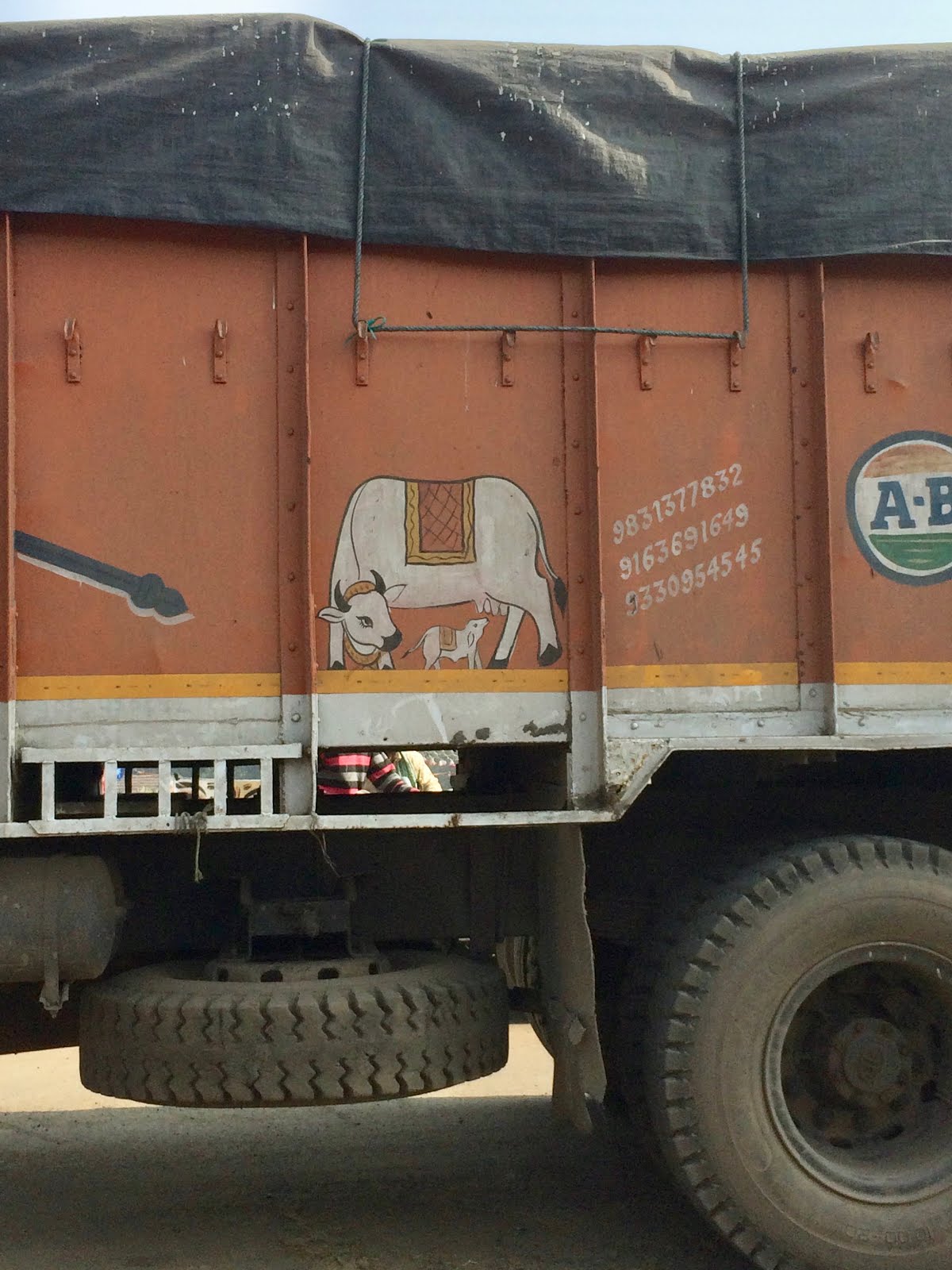
The nursing cow portrayed on the panel was much like some folk paintings I've seen decorating trucks in India.


Another intriguing image showed a wilder side of nature. A family of lions play under the watch of vultures. This scene contrasts with the more gentle pastoral scene.


The style of this portrayal of lions reminded me of the large ceramic statue of a lion I had made in 1983 during my senior year of high school. 


A table cloth with an intricate design of abstracted tree-like forms serves as the ground for these paintings. The border on this cloth creates a wide frame not unlike the complex frames on the dado panels.


Deciding that this white fabric looked too clean and new, I decided to try my luck with a natural indigo dye* bath.


*Indigo dye, cultivated in India, was in high demand during the 19th century, so is in keeping with the time period the portfolio was produced. (Farmers in Bengal revolted against the unfair treatment by the East India Company during British rule in 1859 in what was known as the Indigo revolt).


First a light soak created delicate blue which allowed the golden pattern and yellow color to show.

I worried about losing this pattern when I chose to dip the fabric in the indigo bath longer to achieve a deeper blue, so opted for a gradient ombre effect.


Flora and Fauna II, 2017
58 x 49 1⁄2 inches
Acrylic on indigo dyed fabric


Flora and Fauna I, 2017
 58 x 49 1⁄2 inches
Acrylic on indigo dyed fabric 


Originally these paintings were planned as stretched canvases, but I decided later that they should hang as scrolls. A golden Kalamkari fabric was used to add contrast and warmth to the mostly blue and white paintings. The large common area outside my Kenilworth studio served as a great place to lay these out while cutting the large fabric pieces.!


The finished diptych with rods spans 12 feet.


The next blog post will show more paintings in my Rajasthan Reimagined series for the Look Here! exhibition to be held June 28 - September 16, 2018 at the Villa Terrace Decorative Arts Museum in Milwaukee, Wisconsin. 

This diptych is now available for purchase online at my Etsy shop CynthiaHayesArt


Check out my artwork available at my Etsy store and on my Facebook page as well as my Instagram feed.


Tuesday, March 27, 2018

Icons & Illusions: Solo Exhibition in Decatur, IL - Part II


Welcome to  "Icons & Illusions", my solo exhibition in Decatur, IL. (March 2-28, 2018)


The Anne Lloyd Gallery staff has done a beautiful job arranging and hanging artwork.


This painting of Kartikeya was a good choice for the centerpiece.


Kartikeya on Peacock
65 x 58 inches (64” rods)
acrylic on hand blocked Kalamkari fabric


A painting of Buddha is flanked by River Goddesses Ganga and Yamuna on the end wall.


Another diptych occupies an adjacent wall.


Three images of Ganesh fill another wall.


Golden Ganesh
26” x 20” image
conte and acrylic on paper 
printed with metallic ink


Tables are set up for an Indian themed spread of food and a wine bar as the staff prepares for the opening reception.


An exhibition preview appeared in the newspaper, Decatur Herald and Review, March 1, 2018. I hope this brings attendees to the reception.


People start arriving.


Two featured pianists are scheduled for tonight. 


Larry Wade, first pianist of the evening, starts his performance as the crowd grows.


It is fun meeting everybody. I even have the chance to discuss curriculum with faculty from the local art college.


All gather for the Artist Talk and a series of speeches to celebrate the Decatur Area Arts Council's 50th Anniversary.


Sue Powell, the gallery director, gives me a nice introduction before I say a few words.


Perhaps I should hold this sign while I teach classes at the University of Wisconsin - Milwaukee! 


The second pianist, Mike Waltenberger,  plays some of my favorite melodies and ends the evening with a lovely rendition of "Summertime" from Porgy and Bess.


SOLD!
Teaching Buddha
49 x 43 inches (48” rods)
acrylic on hand blocked Kalamkari fabric


Thank you Decatur Area Arts Council's Anne Lloyd Gallery for the memorable event and the opportunity to exhibit in the Madden Arts Center!

Wednesday, February 21, 2018

Icons & Illusions: Solo Exhibition in Decatur, IL - Part I

I am currently preparing artwork for a solo exhibition in Decatur, Illinois.  Icons & Illusions will be presented by the Decatur Area Arts Council in the Anne Lloyd Gallery at the Madden Arts Center. March 2 - 28, 2018. 

This is the poster for the show.


I will be giving an artist talk at the opening reception On Friday, March 2. Two featured pianists, Larry Wade and Mike Waltenberger, will be performing at the reception. I'm looking forward it. It sounds like a lot of fun!

My next post will include installation photos and pictures from the reception.


Tuesday, February 23, 2016

Depictions of Vishnu : "An Exclusive Expression of Indian Mythology"

Several of the paintings and drawings I recently exhibited in Kolkata, India depict statues of Lord Vishnu, one of the most significant Hindu deities.

Lord Vishnu’s role is that of protector and preserver of the universe. He is a gentle, omnipresent god who is believed to have descended to earth at least nine times in order to save the world from evil and restore balance.


Vishnu I
48 x 36 inches
acrylic on hand blocked fabric

In sacred texts, Vishnu is described as having a dark complexion like water-filled clouds. He is often depicted as a pale blue being in paintings, as are his incarnations Rama and Krishna.

Vishnu’s incarnations, known as avatars, have taken animal and human forms. A tenth incarnation is yet to come. The main focus of the statues depicted in these paintings is Vishnu, not as an avatar, but in his primary spirit form.


Four-Armed Vishnu
30” x 20” image
conte and acrylic on paper printed with metallic ink

Vishnu's stance in the image above is stiff and rigidly formal in the samapada (feet together) pose. Shri Devi and Bhu Devi stand on either side in sensual, curving contrappostoIn many instances, as seen here, Vishnu's wife the goddess Lakshmi manifests as two separate goddesses, Shri Devi denotes energy and Bhu Devi represents fertility.


Vishnu II
48 x 36 inches
acrylic on hand blocked fabric

Depictions of Vishnu adhere to a set system of iconography. Vishnu is represented as a human male with four arms symbolizing his power. The arms in front relate to his activity in the physical world while the rear arms signify Vishnu’s power in the spiritual world. As a symbol of his sovereignty, Vishnu wears a crown. The two earrings worn symbolize opposites inherent in creation.

This Vishnu is elegant in its simplicity and graceful proportions. The broad shouldered figure is softly modeled. His fleshy face has a serene expression with eyes almost closed. Along with a tall cylindrical crown, Vishnu wears armbands, bracelets, necklace and a belt but appears nearly nude as the transparent drapery covering his legs is his only garment. 


Vishnu with Attendants
26” x 20” image
conte on paper

He holds a conch in his forward left hand and a war discus in his rear left. The conch shell he holds is a symbol of the sound of creation. The discus is a weapon reminding the devotee that Vishnu protects the world from evil.

A lotus in his right front hand represents divine spiritual perfection and purity. 

Vishnu also holds a mace (gada) in his right rear hand which signifies divine power in addition to the conch (shankha), lotus (padma), and discus or chakra.


These two sculptures (in the Southeast Asian Collection of the Art Institute of Chicago) served as inspiration for the four artworks above. A simple aureole backs both statues carved in high relief. 

Another statue of Vishnu from the same collection was my model for the mixed media drawing below.


God Vishnu Riding on His Mount, Garuda
26” x 20” image
conte & acrylic on printed paper

All of the paintings and drawings above are for sale. Price available upon request. I am able to supply higher resolution images to interested buyers. If inquiring, please leave a comment with your email address. I will immediately contact you and hide your info from public view.
Or email me at Cynthia.S.Hayes (at) gmail (dot) com