Showing posts with label painting. Show all posts

Tuesday, May 5, 2020

Conch Shell Ganesha

A patron recently commissioned a large portrait of a tiny Ganesha figurine. The unusual sculpture was made to look as if it were assembled of conch shells. The conch is a predatory sea snail found in the Indian Ocean. The Shankha, a conch shell used as a trumpet in Hindu ritual, is praised as a giver of prosperity, longevity, and fame, and is an emblem of the Hindu preserver god Vishnu


Detail of Shanka Ganesha


The painting would be a surprise birthday gift for the man's wife who is especially fond of the little Ganesh statue that holds significance for their family. Lord Ganesha, one of the most worshipped deities in the Hindu pantheon, is the deva of intellect and wisdom. Widely revered as the remover of obstacles,  elephant-headed Ganesh is honored at the start of rites and ceremonies.


Together we selected a beautiful Indian hand-blocked cotton Kalamkari fabric printed with natural vegetable dye to use as the canvas. The fabric design features a large circular mandala with delicate floral and paisley designs. The circular motif would frame the icon like a halo and add another large element to the composition.


Because the painting will be hung on dowels as a scroll, acrylic paint was chosen for its flexibility. The paint will not crack when the scroll is rolled. Another benefit of acrylic here is that it can be used on unprimed cotton canvas without causing the fabric to rot as oil paint would.


Making the uniform brown color of the statue interesting would be a challenge. Another concern was how to incorporate it into a fabric which did not contain brown colors. Using mostly metallic colors, I built up transparent layers of paint which allow the fabric's pattern to show through. This adds depth, complexity, and gives the richness of an aged patina.


A detail of the face (above) shows a good example of the kinds of coincidental occurrences I find fascinating while I paint. Placement of forms often coincide or mirror similar shapes in the pattern of the underlying fabric. Here the arching brows happen to fall inline with the alternating blue and green shapes fanning out from the center of the mandala.


A range of shiny gold, copper, bronze, and silver paints were utilized to emphasize subtle difference in the temperature of light and shadows on the form. Hot red copper was used in the shadows as reflected light bouncing up from the ground while a golden color indicates direct light from above.


Teardrop shaped Paisley motifs, visually rhyming with Ganesha's curling elephant trunk, were scattered to move the viewer's eye around the composition and give relief from the static formal symmetry of the image. I realized mid-stream that the parts of the fabric's central circle left exposed are suggestive of the elephant's ears which are absent on the sculpture.

Shanka Ganesha
acrylic on Kalamkari fabric
54" x 45"


I was given rather short notice, having approximately three weeks to complete the painting by the birthday deadline, but was very happy to spend time on this project during the "safer at home" pandemic weeks of April 2020. Working from home all day everyday, it was nice to be able to alternate between teaching emergency remote college classes online and painting.

The piece was completed on time and the recipient was delighted with her surprise gift! The family happens to be relocating to another state in just two weeks and have promised to send me a photo of the painting installed in their new home. I can't wait to see it displayed!


I am open to doing more special projects on commission. Please feel free to contact me with inquiries. 

Don't forget to check out my artwork available at my Etsy storeFacebook page, as well as my Instagram feed.


Sunday, April 5, 2020

Vajradhara

Recently I have been working on a large oil painting of Vajradhara Buddha, the primordial buddha who represents the essence of the historical Buddha's realization of enlightenment. 

Vajradhara Buddha
Oil and acrylic on Kalamkari fabric
42" x 48"

While visiting China last June, I quickly became enamored with a beautiful Vajradhara statue in the Beijing Capital Museum's ancient buddhist sculpture collection. You can see much of the collection on my post from October 2019. The expressive gentle tilt of the head and delicate positioning of the hands gives a feeling of inward contemplation, wisdom, and enlightenment. I'd need to paint a "portrait" of the Vajradhara so I could spend a considerable amount of time studying this masterpiece. 


Over the past few years, I've been creating acrylic paintings of stone statuary primarily using neutral grays and browns in a grisaille technique. I was, however, so excited by the vibrant Tibetan turquoise inlayed stones and golden color this statue that I knew this would be the perfect opportunity to return to oils which would allow a richness and luminosity. 


Vajradhara
1368-1644


I stretched a hand-blocked cotton Kalamkari fabric from India to use as the canvas. Gold metallic paint was used to stencil ornate designs onto the fabric. I then stained the fabric with washes or acrylic paint to give more contrast, bringing these designs forward.


The fabric needed to be primed prior to using oil paint to protect the fibers from the oil which could rot the fabric over time. Traditionally a white gesso is used as a barrier between the canvas and paint. Because incorporation of the hand-blocked pattern was desired, I experimented with a clear latex paint. Art supply stores have started selling clear gesso, but I have been told it can look cloudy. Rust-oleum Ultra Cover Clear is clearglossy, and also provides UV protection to help keep the fabric from fading.


I was pleased by the way the clear paint changed the look of the yellow fabric, making it look wet. The picture below shows the untreated fabric on the right. You can see the clear paint darkened the yellow fabric causing it to become a deeper golden color which gave it an antique quality that highlighted the subtle parts of the pattern.


I had forgotten how easily the buttery oils glide over the treated surface. Applying the paint was so easy and fun in comparison to the way this raw fabric resists the application of acrylic paint.


A visit to the Small Wild Goose Pagoda in Xi'an ( built between 707-709 during the Tang Dynasty) provided the inspiration for the spinning circular motifs and floral elements that were added next.


Small Wild Goose Pagoda, Xi'an 707-709


Though people are no longer permitted inside the pagoda, a museum is housed in the smaller building pictured in the foreground of the photo below.


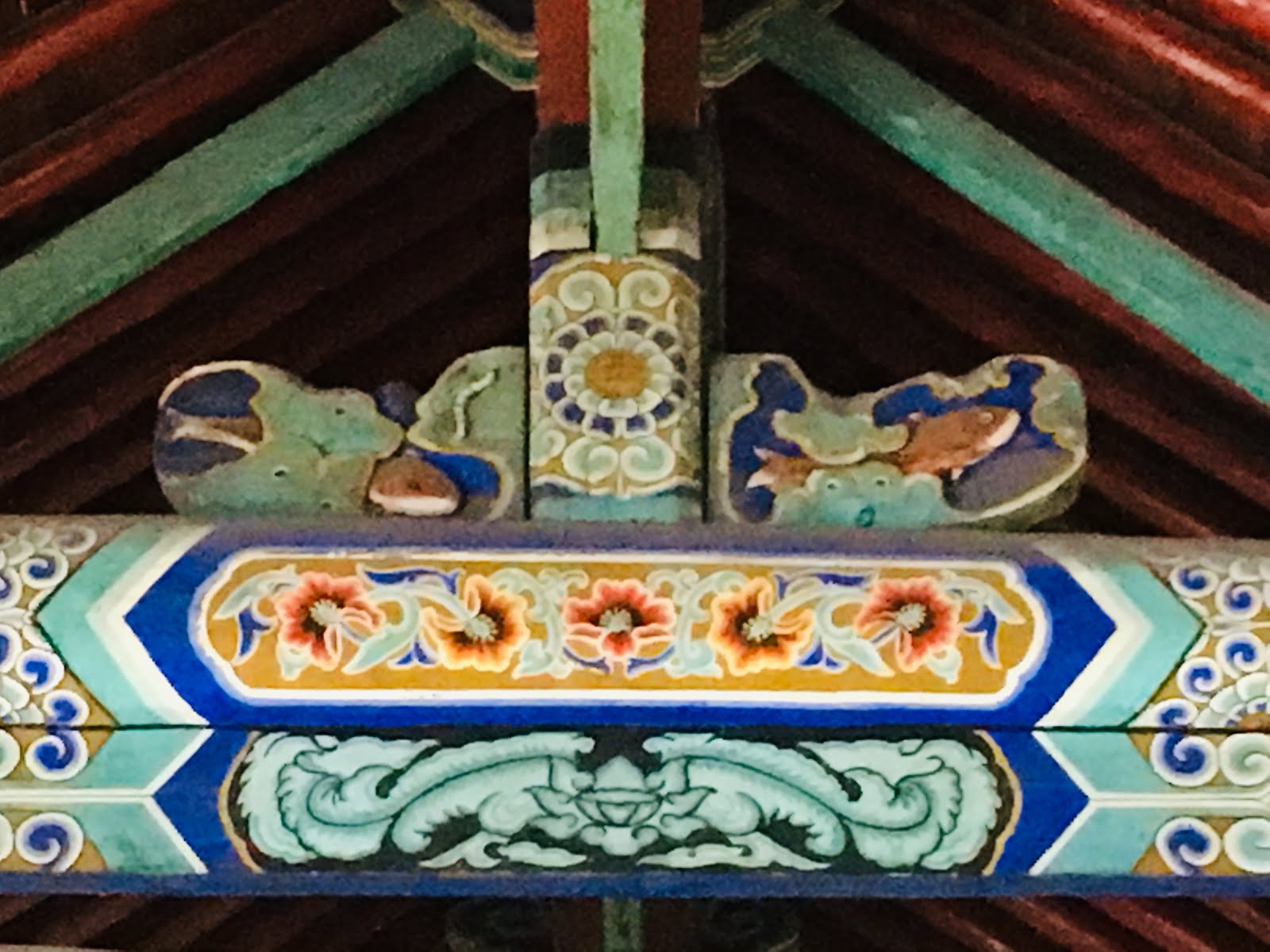
The ceiling of the museum building featured large wooden beams painted with intricate designs.


The color and zigzag patterned border of the fabric I chose was reminiscent of the background of the ceiling designs. 


I added a thin, transparent glaze to age the brilliant blue, white and turquoise spiraling wheels with the look of years of grime.


The use of the same cobalt and robin's egg blue on the leaves seemed a surprising choice for the leaves in the floral designs.


Medallions present in the pattern of the hand-blocked Kalamkari fabric were allowed to replace some of the jewelry on the statue and float freely, playing in space.


Sometimes it is hard to decide when an artwork is finished. Though I intended to add more to this painting, it is telling me to stop. 

Time to start the next new work!

Don't forget to check out my artwork available at my Etsy storeFacebook page, as well as my Instagram feed.


Wednesday, April 17, 2019

Pearls of Wisdom from the Himalayas

I've recently completed a new large diptych inspired by Bhutanese architectural sites I have visited. A few months ago, I posted about a watercolor I had done while experimenting with this idea.

Winds carrying the Three Jewels is a common decorative element on buildings in Bhutan. Several stylized motifs representing the winds have been incorporated in the painting below.


Pearls of Wisdom II
36 x 48 inches
acrylic on Kalamkari fabric


Motivated by a desire to reintroduce bright colors into my painting, I am studying the vibrantly painted Buddhist symbols that decorate Himalayan temples and monasteries. A particularly brilliant blue hue on the doorway pictured below was unlike any I have experienced.  I have attempted to contrast this blue against the very warm colored fabric surface.


A simple circular dharma wheel appears in both panels of the diptych. The golden rims of the wheels enclose "swirls of joy" that spiral outward like a Chinese yin-yang symbol. The four colors swirling together correspond to the four directions and elements, and symbolize the Buddha’s teachings upon the Four Noble Truths. 


Pearls of Wisdom I
36 x 48 inches
acrylic on Kalamkari fabric


The Four Noble Truths contain the essence of the Buddha's teachings.
  1. The truth of suffering (Dukkha)
  2. The truth of the origin of suffering (Samudaya)
  3. The truth of the cessation of suffering (Nirodha)
  4. The truth of the path to the cessation of suffering (Marga)
The Four Noble Truths were presented by the Buddha in the first sermon at Deer Park and are considered one of the most important teachings.

On Christmas Day 2017, I made the pilgrimage to Deer Park in Sarnath, India where the Buddha taught his first taught sermon, the "Dhamma Chakka Pavattana Sutta." The name of this teaching means, "Setting the Wheel of Dhamma in Motion." 


The massive Dhamek Stupa in Sarnath marks the spot where the Buddha gave that first sermon to his first five brahmin disciples.


Some of the intricate sandstone carvings decorating the stupa remain.


The banding of patterns on this block-printed Kalamkari fabric reminded me of the sandstone carvings on the Dhamek Stupa. 


The wide black horizontal and vertical bands on the fabric also reminded me of the black beams on the Bhutanese structure pictured below.


A row of giant white circles on a black beam is startlingly bold in contrast to the ornate geometric designs and complex pastel floral elements on the same facade. These circles may represent the moon. Another row of smaller white circles (or pearls) on an orange background relate to the "flaming pearl", a symbol of wisdom and spiritual awareness. "Pearls" like these are a featured element in my diptych. 


On the lintel shown below, a chrysanthemum motif encloses a pearl and is surrounded by spiraling gusts of wind. Winds carrying the Three Jewels appear on the capitol of the column which is topped with a row of flaming pearls surrounded by golden rings.


Here are links to a few of the informative articles I have been reading about Buddhist Symbolism:

Thursday, March 21, 2019

Artwork on View at Beans and Barley


In January of this year I was attending a gallery night when I saw my long-time friend Allison B. Cooke at a gallery reception. Aside from teaching at and working on her own beautiful paintings, Allison has been for over 30 years helping to boost the local art scene by arranging shows at local restaurant Beans and Barley. She asked me if I wanted to exhibit artwork there and I immediately accepted. 


Special thanks to Allison B. Cooke (right)


Since its founding in 1973, Beans and Barley has been an institution on Milwaukee's East Side. They were among the very first places people could purchase bulk organic and vegan food. Due to a fire, in 1993 "Beans" rebuilt and expanded the store and cafe on the same site which has become a popular destination to meet up in Milwaukee.


Beans and Barley
1901 E. North Ave.
Milwaukee, WI


For this show (my sixth at Beans and Barley since 1987), six of my recent paintings inspired by elements of Rajashan architecture are on display.


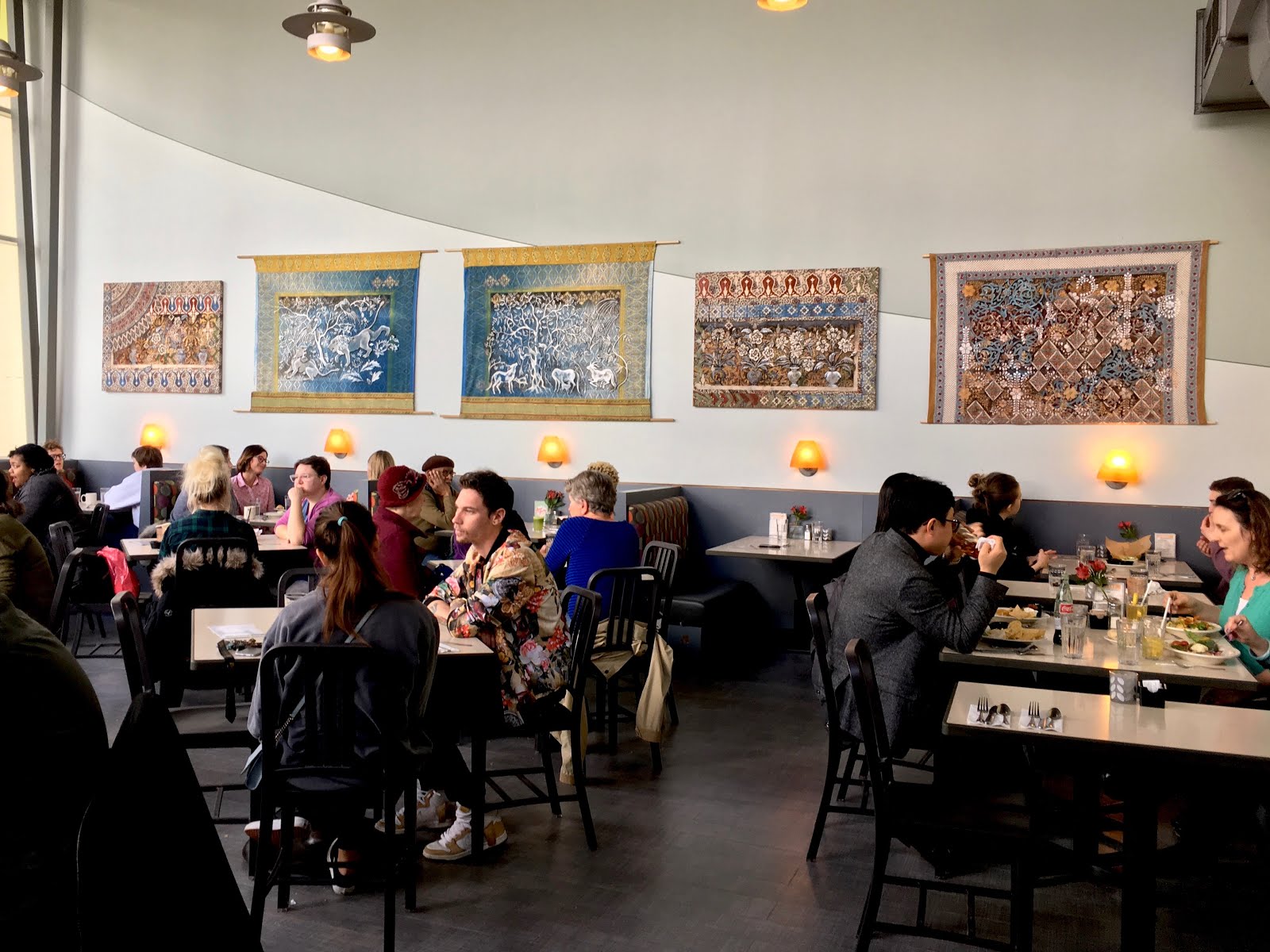
The paintings from my "Rajasthan Reimagined" series are painted on hand-blocked Kalamkari fabrics from India. Some hang as scrolls and others are stretched on wood frames.


Also on exhibit are the paintings of another long-time artist friend Jeff Darrow who I have known since the mid-1980's (about the time I first met Allison).


One of Jeff Darrow's paintings on display 


Thanks for reading about this exhibition. It will be up until early in June 2019 at Beans and Barley, 1901 E. North Avenue, Milwaukee, WI.

Don't forget to check out my artwork available at my Etsy store, Facebook page, as well as my Instagram feed.


Monday, March 4, 2019

Featured Artist at the Milwaukee Art Museum After Dark Event

Today I visited the Milwaukee Art Museum to view the Bouguereau & America exhibition which is on view through May 12, 2019.  One of my favorite paintings was in the exhibit, one I had quoted. My version was shown in the same museum nearly two years ago when I was the featured artist at a Bollywood inspired MAM After Dark event. So, I thought I'd share some photos from that night.


The Broken Pitcher, 1891 by William-Adolphe Bouguereau


I referred to William-Adolphe Bouguereau's The Broken Pitcher in a piece focused on Lord Krishna's young foster mother, Yashoda.  In a popular story about Krishna's childhood, The Butter Theif, the naughty blue boy sneaks into people's homes to steal butter. The women from the village confront Krishna's mother complaining that Krishna has broken their butter pots. The charming boy cozies up to Yashoda, melting her heart. How can she scold him?

Yashoda
oil on canvas
48" x 48"


My other painting of baby Krishna was also shown.


 Gopi Gahani
oil on canvas
48" x 48"

It was great fun watching people examining and posing with my paintings during this event! A few captured moments follow.


My next blogpost will document highlights from the Bouguereau & America exhibition.

Don't forget to check out my artwork available at my Etsy store, Facebook page, as well as my Instagram feed.


Saturday, June 9, 2018

Look Here! Jeypore Dreams Remembered


For the past 18 months, I have been working on a series of paintings for Look Here!, a pilot collaboration with UWM Libraries Digital Humanities Lab and Special Collections. Artists were asked to submit proposals to create artwork based on research involving library resources. 


This project culminates in an exhibition to be held at the the beautiful Villa Terrace Decorative Arts Museum June 28 - September 16, 2018.


Cynthia Hayes
Jeypore Dreams Remembered, 2018
44” x 60”
acrylic on Kalamkari fabric


My Rajasthan Reimagined series is based on my interaction with historical Indian architectural renderings compiled in the Jeypore Portfolio of Architectural Details (1894) which was issued under the patronage of His Highness Maharaja Sawai Madhu Singh G.C.S.I. of Jeypore (today spelled “Jaipur”). Several of the volumes are housed in the UWM Library’s Special Collections.


The twelve volume portfolio is the result of an extensive undertaking initiated in 1887 by British Colonel S.S. Jacob, Engineer to the Jeypore State, to record Rajput architectural wonders in the region in or near Delhi and Agra. Realizing these sites were rapidly decaying, the goal was to produce a reference collection of ornamental patterns to be of practical use to artists and architects. 


Highly accurate original drawings, done by graduates of the Jeypore School of Art, were reproduced in England by W. Griggs and Sons in large scale photo-lithograph plates with hopes they would be used chiefly as working drawings for the artisan. 

“To rescue such designs from oblivion and give them new life is worth something.” — Colonel S.S. Jacob


The color palette of a design (above) and the rendering of a low relief carving (below) inspired my painting Jeypore Dreams Remembered.


I selected a wood block printed Kalamkari fabric on a recent trip to Kolkata


The colors and floral elements were similar to illustrations in the portfolio, so I felt it would be an appropriate surface for a painting integrating some of the patterns. 


I hand cut a stencil of the spiral tendril lattice design. 


Memories of crumbling ornate ironwork I observed in India influenced the broken placement and ghost images of the painted lattice as I worked.


The finished painting is removed from the stretcher and hung as a scroll. The fabric's border becomes a frame. 


Jeypore Dreams Remembered, 2018
44” x 60”
acrylic on Kalamkari fabric


My next blog post will show more paintings in my Rajasthan Reimagined series for the Look Here! exhibition to be held June 28 - September 16, 2018 at the Villa Terrace Decorative Arts Museum in Milwaukee, Wisconsin. 


Check out my artwork available at my Etsy store and on my Facebook page as well as my Instagram feed