Showing posts with label architectural. Show all posts

Wednesday, April 17, 2019

Pearls of Wisdom from the Himalayas

I've recently completed a new large diptych inspired by Bhutanese architectural sites I have visited. A few months ago, I posted about a watercolor I had done while experimenting with this idea.

Winds carrying the Three Jewels is a common decorative element on buildings in Bhutan. Several stylized motifs representing the winds have been incorporated in the painting below.


Pearls of Wisdom II
36 x 48 inches
acrylic on Kalamkari fabric


Motivated by a desire to reintroduce bright colors into my painting, I am studying the vibrantly painted Buddhist symbols that decorate Himalayan temples and monasteries. A particularly brilliant blue hue on the doorway pictured below was unlike any I have experienced.  I have attempted to contrast this blue against the very warm colored fabric surface.


A simple circular dharma wheel appears in both panels of the diptych. The golden rims of the wheels enclose "swirls of joy" that spiral outward like a Chinese yin-yang symbol. The four colors swirling together correspond to the four directions and elements, and symbolize the Buddha’s teachings upon the Four Noble Truths. 


Pearls of Wisdom I
36 x 48 inches
acrylic on Kalamkari fabric


The Four Noble Truths contain the essence of the Buddha's teachings.
  1. The truth of suffering (Dukkha)
  2. The truth of the origin of suffering (Samudaya)
  3. The truth of the cessation of suffering (Nirodha)
  4. The truth of the path to the cessation of suffering (Marga)
The Four Noble Truths were presented by the Buddha in the first sermon at Deer Park and are considered one of the most important teachings.

On Christmas Day 2017, I made the pilgrimage to Deer Park in Sarnath, India where the Buddha taught his first taught sermon, the "Dhamma Chakka Pavattana Sutta." The name of this teaching means, "Setting the Wheel of Dhamma in Motion." 


The massive Dhamek Stupa in Sarnath marks the spot where the Buddha gave that first sermon to his first five brahmin disciples.


Some of the intricate sandstone carvings decorating the stupa remain.


The banding of patterns on this block-printed Kalamkari fabric reminded me of the sandstone carvings on the Dhamek Stupa. 


The wide black horizontal and vertical bands on the fabric also reminded me of the black beams on the Bhutanese structure pictured below.


A row of giant white circles on a black beam is startlingly bold in contrast to the ornate geometric designs and complex pastel floral elements on the same facade. These circles may represent the moon. Another row of smaller white circles (or pearls) on an orange background relate to the "flaming pearl", a symbol of wisdom and spiritual awareness. "Pearls" like these are a featured element in my diptych. 


On the lintel shown below, a chrysanthemum motif encloses a pearl and is surrounded by spiraling gusts of wind. Winds carrying the Three Jewels appear on the capitol of the column which is topped with a row of flaming pearls surrounded by golden rings.


Here are links to a few of the informative articles I have been reading about Buddhist Symbolism:

Sunday, September 30, 2018

Himalayan Winds, New Work Inspired by Architecture of Bhutan

I am contemplating the idea of new series of paintings inspired by architectural sites I've visited in the Himalayan country of Bhutan.

I rarely do watercolor paintings, but wanted to try a color palette common to architecture of the region. Watercolor seemed an efficient medium for experimentation. The painting below is my first attempt, a preliminary study for a large painting on a patterned fabric.


Himalayan Winds
2018
watercolor
18 x 24 inches


Sites including temples, monasteries, and Dzongs in Bhutan are highly decorated with brightly painted carved patterns. 


All of the elements in these designs have symbolic Buddhist meaning. I am learning about this symbolism while studying these intricate patterns.


An ubiquitous orange hue is used as the background color for designs on many structures. This color appears on half of the Bhutan flag to represent spiritual power and the Drukpas monasteries. A saffron yellow signifies the authority of the dynasty.


The concentric circles on the beam above are a stylized "flaming pearl" symbolic of wisdom and spiritual awareness.  Directly below we see the Trinata symbolizing the "triple gems" of Buddhism (Buddha, Dharma, and Sangha).The water is symbolic of clarity and calmness.


Abstract wind designs represent the flow of energy, called rLung, most closely connected with air. rLung is a concept that is particularly important in Vajrayana traditions of Tibetan Buddhism. Its most important function is to carry the movements of mind, speech and body, the Three Vajras.


Chrysanthemum flowers are used as offerings on alters. They are symbolic of powerful Yang energy, which means they attract good luck into the home.


A stylized Chrysanthemum flower


Here are links to a few of the informative articles I have been reading about Buddhist Symbolism:

Thursday, June 21, 2018

Look Here! Flora and Fauna

Having had a long interest in Asian art history, much of the artwork I've made in recent years has been based on ancient Buddhist and Hindu sculpture studied on research trips to Bhutan, India, and Thailand.  


So on my first research visit to the UWM Special Collections library for the "Look Here!" initiative, I was immediately taken with the Dados volume of the Jeypore Portfolio of Architectural Detail. (Three volumes of the beautiful 12 volume portfolio are housed in the UWM library.) 


Dado is an architectural term that describes a panel above the chair rail. This area is given a decorative treatment. 

The illustrations recorded lovely low relief wall carvings of landscapes. A wide variety of different trees and plants are represented in a stylized treatment.


I fell in love with this image of monkeys playing in a Banyan tree where cattle graze below. 


It reminded me of this ancient tree I visited on the banks of the Ganges where Paramahansa Yogananda walked  in Serampore, West Bengal, India.


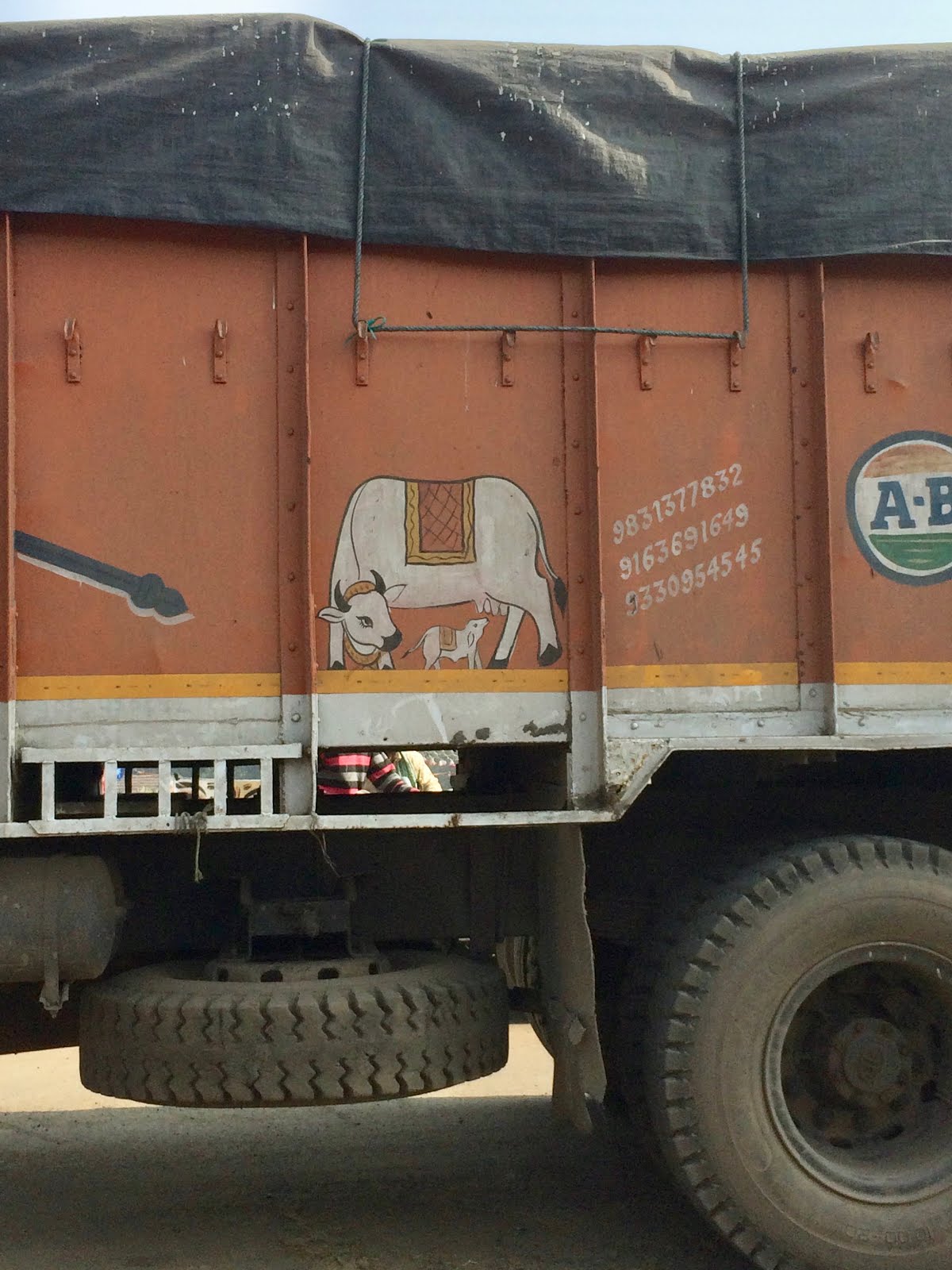
The nursing cow portrayed on the panel was much like some folk paintings I've seen decorating trucks in India.


Another intriguing image showed a wilder side of nature. A family of lions play under the watch of vultures. This scene contrasts with the more gentle pastoral scene.


The style of this portrayal of lions reminded me of the large ceramic statue of a lion I had made in 1983 during my senior year of high school. 


A table cloth with an intricate design of abstracted tree-like forms serves as the ground for these paintings. The border on this cloth creates a wide frame not unlike the complex frames on the dado panels.


Deciding that this white fabric looked too clean and new, I decided to try my luck with a natural indigo dye* bath.


*Indigo dye, cultivated in India, was in high demand during the 19th century, so is in keeping with the time period the portfolio was produced. (Farmers in Bengal revolted against the unfair treatment by the East India Company during British rule in 1859 in what was known as the Indigo revolt).


First a light soak created delicate blue which allowed the golden pattern and yellow color to show.

I worried about losing this pattern when I chose to dip the fabric in the indigo bath longer to achieve a deeper blue, so opted for a gradient ombre effect.


Flora and Fauna II, 2017
58 x 49 1⁄2 inches
Acrylic on indigo dyed fabric


Flora and Fauna I, 2017
 58 x 49 1⁄2 inches
Acrylic on indigo dyed fabric 


Originally these paintings were planned as stretched canvases, but I decided later that they should hang as scrolls. A golden Kalamkari fabric was used to add contrast and warmth to the mostly blue and white paintings. The large common area outside my Kenilworth studio served as a great place to lay these out while cutting the large fabric pieces.!


The finished diptych with rods spans 12 feet.


The next blog post will show more paintings in my Rajasthan Reimagined series for the Look Here! exhibition to be held June 28 - September 16, 2018 at the Villa Terrace Decorative Arts Museum in Milwaukee, Wisconsin. 

This diptych is now available for purchase online at my Etsy shop CynthiaHayesArt


Check out my artwork available at my Etsy store and on my Facebook page as well as my Instagram feed.


Saturday, June 9, 2018

Look Here! Jeypore Dreams Remembered


For the past 18 months, I have been working on a series of paintings for Look Here!, a pilot collaboration with UWM Libraries Digital Humanities Lab and Special Collections. Artists were asked to submit proposals to create artwork based on research involving library resources. 


This project culminates in an exhibition to be held at the the beautiful Villa Terrace Decorative Arts Museum June 28 - September 16, 2018.


Cynthia Hayes
Jeypore Dreams Remembered, 2018
44” x 60”
acrylic on Kalamkari fabric


My Rajasthan Reimagined series is based on my interaction with historical Indian architectural renderings compiled in the Jeypore Portfolio of Architectural Details (1894) which was issued under the patronage of His Highness Maharaja Sawai Madhu Singh G.C.S.I. of Jeypore (today spelled “Jaipur”). Several of the volumes are housed in the UWM Library’s Special Collections.


The twelve volume portfolio is the result of an extensive undertaking initiated in 1887 by British Colonel S.S. Jacob, Engineer to the Jeypore State, to record Rajput architectural wonders in the region in or near Delhi and Agra. Realizing these sites were rapidly decaying, the goal was to produce a reference collection of ornamental patterns to be of practical use to artists and architects. 


Highly accurate original drawings, done by graduates of the Jeypore School of Art, were reproduced in England by W. Griggs and Sons in large scale photo-lithograph plates with hopes they would be used chiefly as working drawings for the artisan. 

“To rescue such designs from oblivion and give them new life is worth something.” — Colonel S.S. Jacob


The color palette of a design (above) and the rendering of a low relief carving (below) inspired my painting Jeypore Dreams Remembered.


I selected a wood block printed Kalamkari fabric on a recent trip to Kolkata


The colors and floral elements were similar to illustrations in the portfolio, so I felt it would be an appropriate surface for a painting integrating some of the patterns. 


I hand cut a stencil of the spiral tendril lattice design. 


Memories of crumbling ornate ironwork I observed in India influenced the broken placement and ghost images of the painted lattice as I worked.


The finished painting is removed from the stretcher and hung as a scroll. The fabric's border becomes a frame. 


Jeypore Dreams Remembered, 2018
44” x 60”
acrylic on Kalamkari fabric


My next blog post will show more paintings in my Rajasthan Reimagined series for the Look Here! exhibition to be held June 28 - September 16, 2018 at the Villa Terrace Decorative Arts Museum in Milwaukee, Wisconsin. 


Check out my artwork available at my Etsy store and on my Facebook page as well as my Instagram feed