Showing posts with label acrylic. Show all posts

Tuesday, May 5, 2020

Conch Shell Ganesha

A patron recently commissioned a large portrait of a tiny Ganesha figurine. The unusual sculpture was made to look as if it were assembled of conch shells. The conch is a predatory sea snail found in the Indian Ocean. The Shankha, a conch shell used as a trumpet in Hindu ritual, is praised as a giver of prosperity, longevity, and fame, and is an emblem of the Hindu preserver god Vishnu


Detail of Shanka Ganesha


The painting would be a surprise birthday gift for the man's wife who is especially fond of the little Ganesh statue that holds significance for their family. Lord Ganesha, one of the most worshipped deities in the Hindu pantheon, is the deva of intellect and wisdom. Widely revered as the remover of obstacles,  elephant-headed Ganesh is honored at the start of rites and ceremonies.


Together we selected a beautiful Indian hand-blocked cotton Kalamkari fabric printed with natural vegetable dye to use as the canvas. The fabric design features a large circular mandala with delicate floral and paisley designs. The circular motif would frame the icon like a halo and add another large element to the composition.


Because the painting will be hung on dowels as a scroll, acrylic paint was chosen for its flexibility. The paint will not crack when the scroll is rolled. Another benefit of acrylic here is that it can be used on unprimed cotton canvas without causing the fabric to rot as oil paint would.


Making the uniform brown color of the statue interesting would be a challenge. Another concern was how to incorporate it into a fabric which did not contain brown colors. Using mostly metallic colors, I built up transparent layers of paint which allow the fabric's pattern to show through. This adds depth, complexity, and gives the richness of an aged patina.


A detail of the face (above) shows a good example of the kinds of coincidental occurrences I find fascinating while I paint. Placement of forms often coincide or mirror similar shapes in the pattern of the underlying fabric. Here the arching brows happen to fall inline with the alternating blue and green shapes fanning out from the center of the mandala.


A range of shiny gold, copper, bronze, and silver paints were utilized to emphasize subtle difference in the temperature of light and shadows on the form. Hot red copper was used in the shadows as reflected light bouncing up from the ground while a golden color indicates direct light from above.


Teardrop shaped Paisley motifs, visually rhyming with Ganesha's curling elephant trunk, were scattered to move the viewer's eye around the composition and give relief from the static formal symmetry of the image. I realized mid-stream that the parts of the fabric's central circle left exposed are suggestive of the elephant's ears which are absent on the sculpture.

Shanka Ganesha
acrylic on Kalamkari fabric
54" x 45"


I was given rather short notice, having approximately three weeks to complete the painting by the birthday deadline, but was very happy to spend time on this project during the "safer at home" pandemic weeks of April 2020. Working from home all day everyday, it was nice to be able to alternate between teaching emergency remote college classes online and painting.

The piece was completed on time and the recipient was delighted with her surprise gift! The family happens to be relocating to another state in just two weeks and have promised to send me a photo of the painting installed in their new home. I can't wait to see it displayed!


I am open to doing more special projects on commission. Please feel free to contact me with inquiries. 

Don't forget to check out my artwork available at my Etsy storeFacebook page, as well as my Instagram feed.


Wednesday, April 17, 2019

Pearls of Wisdom from the Himalayas

I've recently completed a new large diptych inspired by Bhutanese architectural sites I have visited. A few months ago, I posted about a watercolor I had done while experimenting with this idea.

Winds carrying the Three Jewels is a common decorative element on buildings in Bhutan. Several stylized motifs representing the winds have been incorporated in the painting below.


Pearls of Wisdom II
36 x 48 inches
acrylic on Kalamkari fabric


Motivated by a desire to reintroduce bright colors into my painting, I am studying the vibrantly painted Buddhist symbols that decorate Himalayan temples and monasteries. A particularly brilliant blue hue on the doorway pictured below was unlike any I have experienced.  I have attempted to contrast this blue against the very warm colored fabric surface.


A simple circular dharma wheel appears in both panels of the diptych. The golden rims of the wheels enclose "swirls of joy" that spiral outward like a Chinese yin-yang symbol. The four colors swirling together correspond to the four directions and elements, and symbolize the Buddha’s teachings upon the Four Noble Truths. 


Pearls of Wisdom I
36 x 48 inches
acrylic on Kalamkari fabric


The Four Noble Truths contain the essence of the Buddha's teachings.
  1. The truth of suffering (Dukkha)
  2. The truth of the origin of suffering (Samudaya)
  3. The truth of the cessation of suffering (Nirodha)
  4. The truth of the path to the cessation of suffering (Marga)
The Four Noble Truths were presented by the Buddha in the first sermon at Deer Park and are considered one of the most important teachings.

On Christmas Day 2017, I made the pilgrimage to Deer Park in Sarnath, India where the Buddha taught his first taught sermon, the "Dhamma Chakka Pavattana Sutta." The name of this teaching means, "Setting the Wheel of Dhamma in Motion." 


The massive Dhamek Stupa in Sarnath marks the spot where the Buddha gave that first sermon to his first five brahmin disciples.


Some of the intricate sandstone carvings decorating the stupa remain.


The banding of patterns on this block-printed Kalamkari fabric reminded me of the sandstone carvings on the Dhamek Stupa. 


The wide black horizontal and vertical bands on the fabric also reminded me of the black beams on the Bhutanese structure pictured below.


A row of giant white circles on a black beam is startlingly bold in contrast to the ornate geometric designs and complex pastel floral elements on the same facade. These circles may represent the moon. Another row of smaller white circles (or pearls) on an orange background relate to the "flaming pearl", a symbol of wisdom and spiritual awareness. "Pearls" like these are a featured element in my diptych. 


On the lintel shown below, a chrysanthemum motif encloses a pearl and is surrounded by spiraling gusts of wind. Winds carrying the Three Jewels appear on the capitol of the column which is topped with a row of flaming pearls surrounded by golden rings.


Here are links to a few of the informative articles I have been reading about Buddhist Symbolism:

Thursday, March 21, 2019

Artwork on View at Beans and Barley


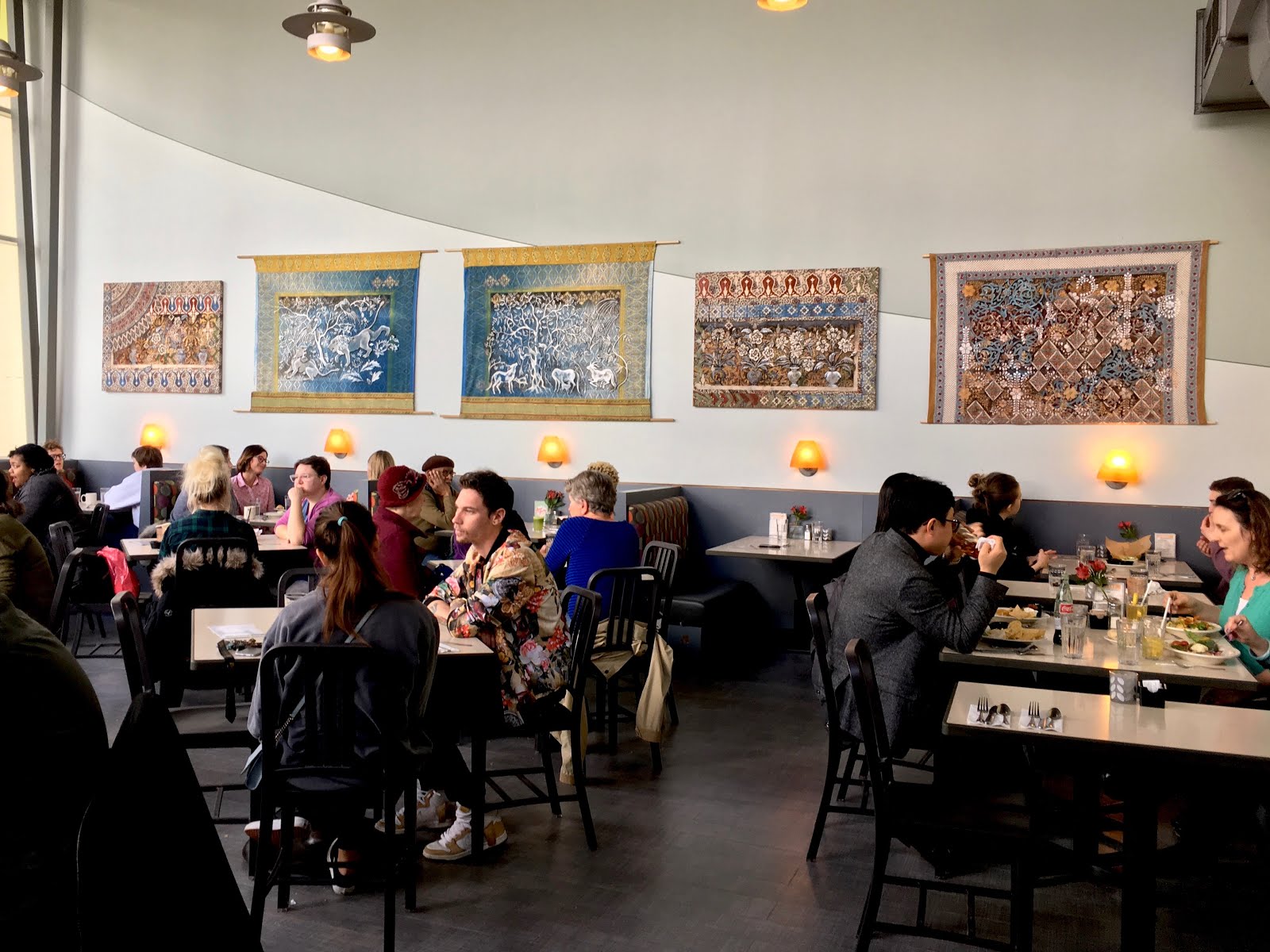
In January of this year I was attending a gallery night when I saw my long-time friend Allison B. Cooke at a gallery reception. Aside from teaching at and working on her own beautiful paintings, Allison has been for over 30 years helping to boost the local art scene by arranging shows at local restaurant Beans and Barley. She asked me if I wanted to exhibit artwork there and I immediately accepted. 


Special thanks to Allison B. Cooke (right)


Since its founding in 1973, Beans and Barley has been an institution on Milwaukee's East Side. They were among the very first places people could purchase bulk organic and vegan food. Due to a fire, in 1993 "Beans" rebuilt and expanded the store and cafe on the same site which has become a popular destination to meet up in Milwaukee.


Beans and Barley
1901 E. North Ave.
Milwaukee, WI


For this show (my sixth at Beans and Barley since 1987), six of my recent paintings inspired by elements of Rajashan architecture are on display.


The paintings from my "Rajasthan Reimagined" series are painted on hand-blocked Kalamkari fabrics from India. Some hang as scrolls and others are stretched on wood frames.


Also on exhibit are the paintings of another long-time artist friend Jeff Darrow who I have known since the mid-1980's (about the time I first met Allison).


One of Jeff Darrow's paintings on display 


Thanks for reading about this exhibition. It will be up until early in June 2019 at Beans and Barley, 1901 E. North Avenue, Milwaukee, WI.

Don't forget to check out my artwork available at my Etsy store, Facebook page, as well as my Instagram feed.


Thursday, June 21, 2018

Look Here! Flora and Fauna

Having had a long interest in Asian art history, much of the artwork I've made in recent years has been based on ancient Buddhist and Hindu sculpture studied on research trips to Bhutan, India, and Thailand.  


So on my first research visit to the UWM Special Collections library for the "Look Here!" initiative, I was immediately taken with the Dados volume of the Jeypore Portfolio of Architectural Detail. (Three volumes of the beautiful 12 volume portfolio are housed in the UWM library.) 


Dado is an architectural term that describes a panel above the chair rail. This area is given a decorative treatment. 

The illustrations recorded lovely low relief wall carvings of landscapes. A wide variety of different trees and plants are represented in a stylized treatment.


I fell in love with this image of monkeys playing in a Banyan tree where cattle graze below. 


It reminded me of this ancient tree I visited on the banks of the Ganges where Paramahansa Yogananda walked  in Serampore, West Bengal, India.


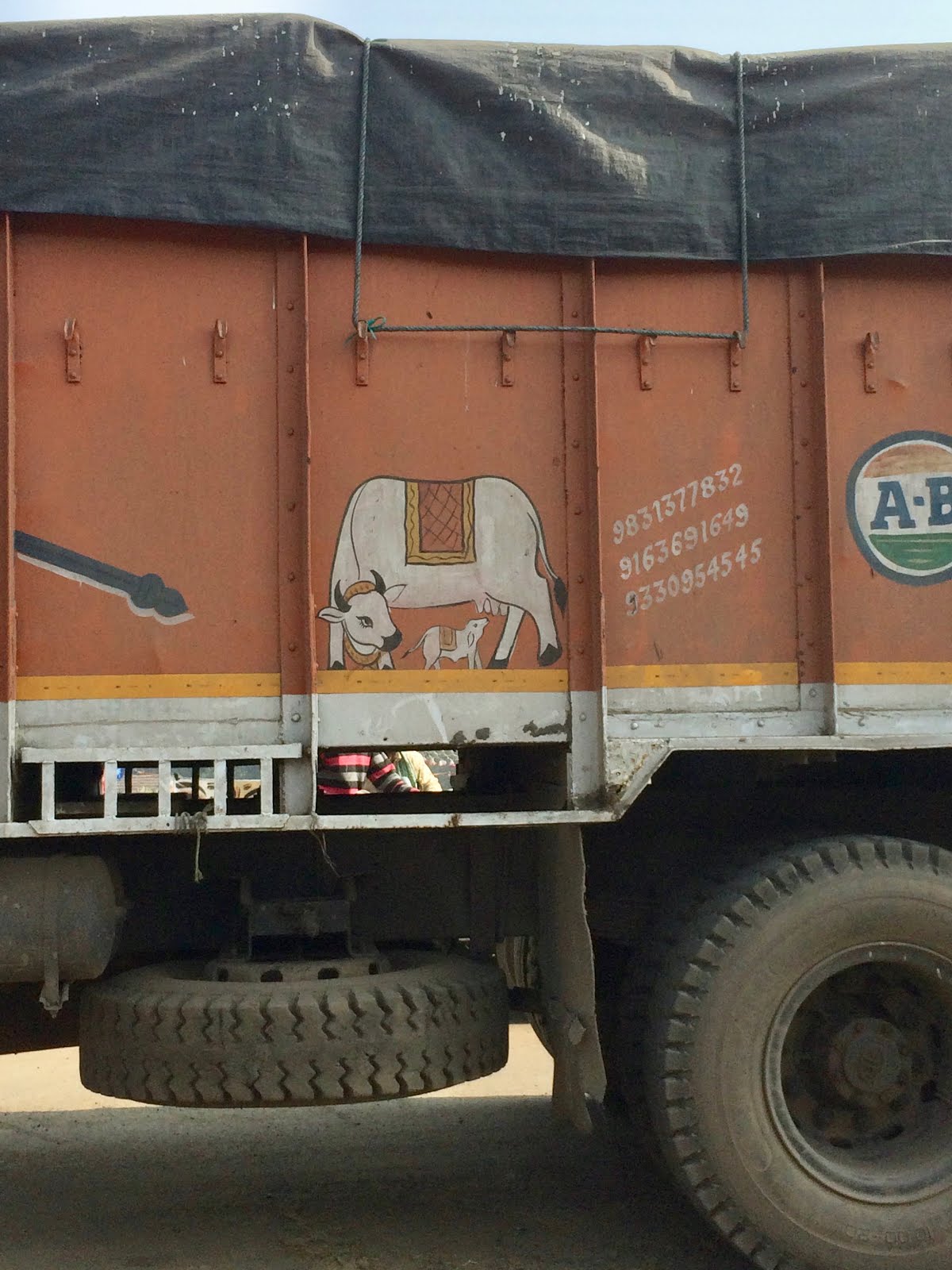
The nursing cow portrayed on the panel was much like some folk paintings I've seen decorating trucks in India.


Another intriguing image showed a wilder side of nature. A family of lions play under the watch of vultures. This scene contrasts with the more gentle pastoral scene.


The style of this portrayal of lions reminded me of the large ceramic statue of a lion I had made in 1983 during my senior year of high school. 


A table cloth with an intricate design of abstracted tree-like forms serves as the ground for these paintings. The border on this cloth creates a wide frame not unlike the complex frames on the dado panels.


Deciding that this white fabric looked too clean and new, I decided to try my luck with a natural indigo dye* bath.


*Indigo dye, cultivated in India, was in high demand during the 19th century, so is in keeping with the time period the portfolio was produced. (Farmers in Bengal revolted against the unfair treatment by the East India Company during British rule in 1859 in what was known as the Indigo revolt).


First a light soak created delicate blue which allowed the golden pattern and yellow color to show.

I worried about losing this pattern when I chose to dip the fabric in the indigo bath longer to achieve a deeper blue, so opted for a gradient ombre effect.


Flora and Fauna II, 2017
58 x 49 1⁄2 inches
Acrylic on indigo dyed fabric


Flora and Fauna I, 2017
 58 x 49 1⁄2 inches
Acrylic on indigo dyed fabric 


Originally these paintings were planned as stretched canvases, but I decided later that they should hang as scrolls. A golden Kalamkari fabric was used to add contrast and warmth to the mostly blue and white paintings. The large common area outside my Kenilworth studio served as a great place to lay these out while cutting the large fabric pieces.!


The finished diptych with rods spans 12 feet.


The next blog post will show more paintings in my Rajasthan Reimagined series for the Look Here! exhibition to be held June 28 - September 16, 2018 at the Villa Terrace Decorative Arts Museum in Milwaukee, Wisconsin. 

This diptych is now available for purchase online at my Etsy shop CynthiaHayesArt


Check out my artwork available at my Etsy store and on my Facebook page as well as my Instagram feed.


Saturday, June 9, 2018

Look Here! Jeypore Dreams Remembered


For the past 18 months, I have been working on a series of paintings for Look Here!, a pilot collaboration with UWM Libraries Digital Humanities Lab and Special Collections. Artists were asked to submit proposals to create artwork based on research involving library resources. 


This project culminates in an exhibition to be held at the the beautiful Villa Terrace Decorative Arts Museum June 28 - September 16, 2018.


Cynthia Hayes
Jeypore Dreams Remembered, 2018
44” x 60”
acrylic on Kalamkari fabric


My Rajasthan Reimagined series is based on my interaction with historical Indian architectural renderings compiled in the Jeypore Portfolio of Architectural Details (1894) which was issued under the patronage of His Highness Maharaja Sawai Madhu Singh G.C.S.I. of Jeypore (today spelled “Jaipur”). Several of the volumes are housed in the UWM Library’s Special Collections.


The twelve volume portfolio is the result of an extensive undertaking initiated in 1887 by British Colonel S.S. Jacob, Engineer to the Jeypore State, to record Rajput architectural wonders in the region in or near Delhi and Agra. Realizing these sites were rapidly decaying, the goal was to produce a reference collection of ornamental patterns to be of practical use to artists and architects. 


Highly accurate original drawings, done by graduates of the Jeypore School of Art, were reproduced in England by W. Griggs and Sons in large scale photo-lithograph plates with hopes they would be used chiefly as working drawings for the artisan. 

“To rescue such designs from oblivion and give them new life is worth something.” — Colonel S.S. Jacob


The color palette of a design (above) and the rendering of a low relief carving (below) inspired my painting Jeypore Dreams Remembered.


I selected a wood block printed Kalamkari fabric on a recent trip to Kolkata


The colors and floral elements were similar to illustrations in the portfolio, so I felt it would be an appropriate surface for a painting integrating some of the patterns. 


I hand cut a stencil of the spiral tendril lattice design. 


Memories of crumbling ornate ironwork I observed in India influenced the broken placement and ghost images of the painted lattice as I worked.


The finished painting is removed from the stretcher and hung as a scroll. The fabric's border becomes a frame. 


Jeypore Dreams Remembered, 2018
44” x 60”
acrylic on Kalamkari fabric


My next blog post will show more paintings in my Rajasthan Reimagined series for the Look Here! exhibition to be held June 28 - September 16, 2018 at the Villa Terrace Decorative Arts Museum in Milwaukee, Wisconsin. 


Check out my artwork available at my Etsy store and on my Facebook page as well as my Instagram feed

Tuesday, March 27, 2018

Icons & Illusions: Solo Exhibition in Decatur, IL - Part II


Welcome to  "Icons & Illusions", my solo exhibition in Decatur, IL. (March 2-28, 2018)


The Anne Lloyd Gallery staff has done a beautiful job arranging and hanging artwork.


This painting of Kartikeya was a good choice for the centerpiece.


Kartikeya on Peacock
65 x 58 inches (64” rods)
acrylic on hand blocked Kalamkari fabric


A painting of Buddha is flanked by River Goddesses Ganga and Yamuna on the end wall.


Another diptych occupies an adjacent wall.


Three images of Ganesh fill another wall.


Golden Ganesh
26” x 20” image
conte and acrylic on paper 
printed with metallic ink


Tables are set up for an Indian themed spread of food and a wine bar as the staff prepares for the opening reception.


An exhibition preview appeared in the newspaper, Decatur Herald and Review, March 1, 2018. I hope this brings attendees to the reception.


People start arriving.


Two featured pianists are scheduled for tonight. 


Larry Wade, first pianist of the evening, starts his performance as the crowd grows.


It is fun meeting everybody. I even have the chance to discuss curriculum with faculty from the local art college.


All gather for the Artist Talk and a series of speeches to celebrate the Decatur Area Arts Council's 50th Anniversary.


Sue Powell, the gallery director, gives me a nice introduction before I say a few words.


Perhaps I should hold this sign while I teach classes at the University of Wisconsin - Milwaukee! 


The second pianist, Mike Waltenberger,  plays some of my favorite melodies and ends the evening with a lovely rendition of "Summertime" from Porgy and Bess.


SOLD!
Teaching Buddha
49 x 43 inches (48” rods)
acrylic on hand blocked Kalamkari fabric


Thank you Decatur Area Arts Council's Anne Lloyd Gallery for the memorable event and the opportunity to exhibit in the Madden Arts Center!