Sunday, October 6, 2019

Beijing Capital Museum's Ancient Buddhist Sculpture Collection


On a recent trip to Beijing, I spent a day visiting the Capital Museum.  


Architects Jean-Marie Duthilleuland and Cui Kai designed the Capital Museum building with a massive roof influenced by ancient Chinese architecture.


A decorative archway from the Ming Dynasty welcomes guests in the large reception hall.


This impressive institution contains over 200,000 ancient calligraphy, painting,  porcelain, bronze,  and jade relics. I, however, chose to spend the day immersed in the Ancient Buddhist Sculpture collection.

I photographed nearly all the sculptures that were on display during June of 2019. I'm sharing most here.

Not much information was presented in English, but I have provided what was available with each image to follow.


Pujadevi
1368-1644


Eastern Pujadevi
1368-1644


Vajrabhairava
1368-1644


1368-1644 


Sakyamuni Buddha and Two Attendant Bodhisattvas
499


 AD 1532


1368-1644


1368-1644


Ksitigarbha Bodhisattva 
1368-1644


Avalokitesvara Bodhisattva 
1368-1644


Bhaisajyaguru Buddha 
1368-1644


Bhaisajyaguru Buddha 


Amitabha Buddha
7th-9th century


Eleven-faced Avelokitesvara
15th century


Vajrasattva Bodhisattva
1271-1368


Sakyamuni Buddha


Maitreya Buddha
7th-9th century


Aksobhya Buddha
1271-1368


Vajrasattva Bodhisattva
1271-1368


Tara 
1278-1368


Amitayua Buddha
1268-1644


Sakyamuni Buddha
1368-1644


Maitreya Buddha
1368-1644


Maitreya Bodhisattva
1368-1644


Manjusri Bodhisattva with Six Arms
1368-1644


Maitreya Bodhisattva
1368-1644


Vajrapani Bodhisattva
1368-1644


Vajrabhairava
1368-1644


Maijusri Bodhisattva
1368-1644


Goddess Sarawati
1368-1644


This Mahasiddha Gugureba is shown holding his faithful dog. Gugureba  (Kukkuripa in Bengali) was a mahasiddha, a practitioner of yoga and tantra, in India. During his travels he compassionately cared for a stray dog. After 12 years of meditation, he was invited into the heavenly realm where he enjoyed feasts and many pleasures, but would think about the loyal dog he left behind. Seeing his dog had grown sad, thin, and hungry, he renounced the comforts of heaven to return to his dog, realizing that there are things greater than temptation. This beautiful statue clearly captures the joy both master and dog felt upon being reunited.


Mahasiddha Gugureba
1368-1644


Tara
1644-1911


Green Tara
1644-1911


Varuna, the Ocean God, is depicted on his mount Makara, a half terrestrial animal in the front and half aquatic animal in the rear part. This Makara has an elephant's trunk and a dragon-like body.


Varuna
1644-1911


Mahabrahman
1644-1911


Green Tara
1644-1911


Vajrabhairava looks fierce, but represents the Mahayana practitioner's goal of enlightenment . In awakening, one adopts the practice of Yamantaka "terminating death".

1644-1911


Eight-armed Goddess of Suyong
1736-1795


Manjusri Boddhisatva is often depicted brandishing the sword of wisdom.


Manjusri Bodhisattva with Four Arms
1403-1424


Vajrapani Bodhisattva
1403-1492


Maitrey Bodhisattva
1403-1424


Aksobhya Buddha
1403-1424


Goddess Usnisavijara
1368-1644


Goddess Marici


I became enamored with the sensitive handling of this Vajradhara. The gentle tilt of the head and elegant positioning of the hands made this statue my immediate choice as inspiration for my first painting once I returned home. A future blog post will feature that painting.

Vajradhara
1368-1644


Don't forget to check out my artwork available at my Etsy store, Facebook page, as well as my Instagram feed.

Sunday, September 22, 2019

SumTotal 2019 Department of Art and Design Faculty Exhibition at University of Wisconsin - Milwaukee

SumTotal 2019 is a biennial exhibition of artwork by the Department of Art and Design faculty at the University of Wisconsin - Milwaukee. The show dates have been extended. It will be on view through September 28, 2019 in the INOVA Gallery at Kenilworth Square East.


Thank you for this photo Kyoung Ae Cho!


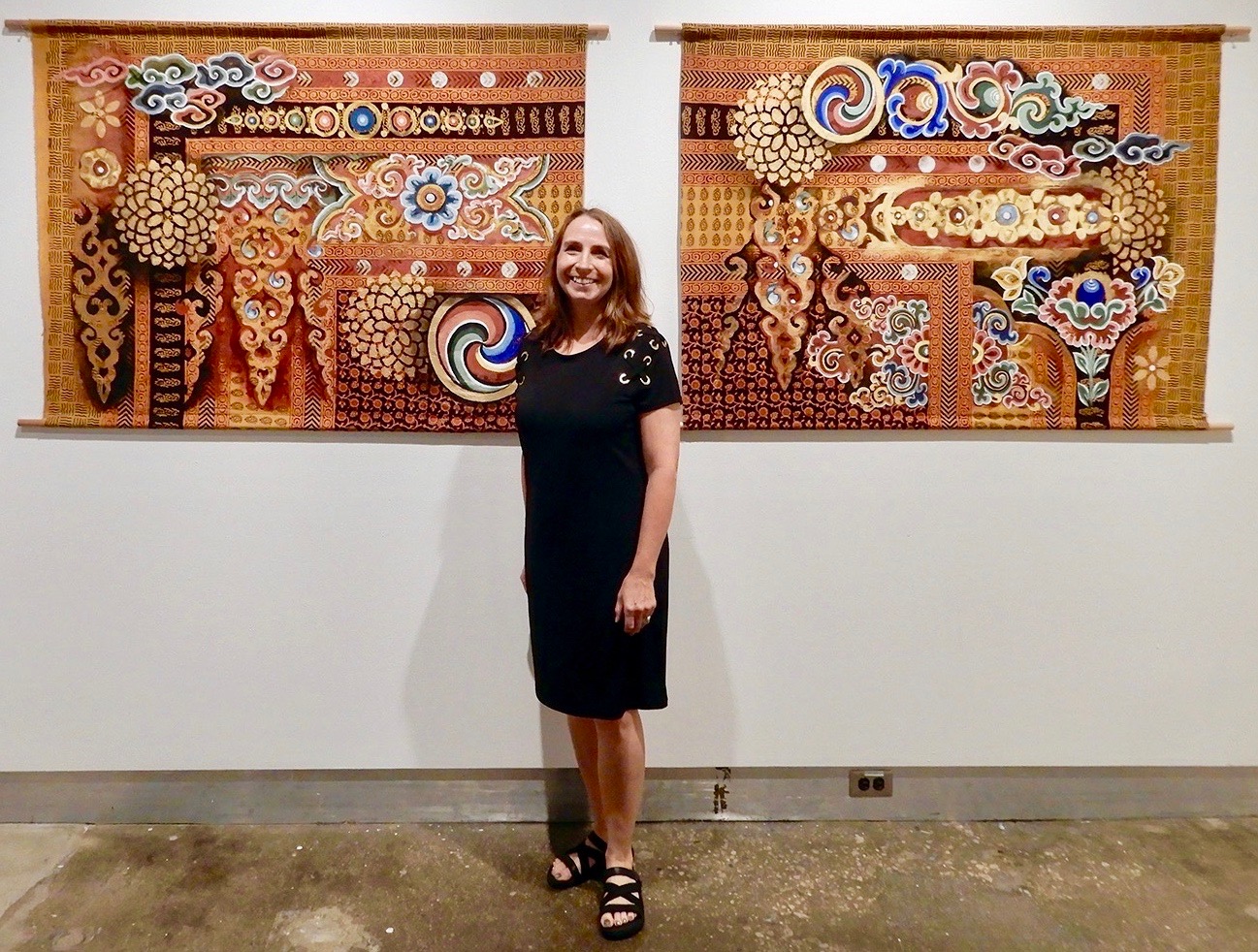
A diptych, "Pearls of Wisdom from the Himalayas", done in acrylic paint on Kalamkari hand-blocked fabric is my entry this year. The piece is approximately nine feet wide when the two panels are hung together in this way. 

Read more about this diptych on a previous blogpost: 
Pearls of Wisdom from the Himalayas


The show announcement -


A list of participating Peck School of the Arts Department of Art and Design Faculty is shown.


This is the first time I have exhibited in this beautiful gallery space. It's an honor to work with and have my work included in a show with this fine group of colleagues!


Pictured from left to right are works by Jarrod Patton-Plock, 
Cynthia Hayes, Raoul Deal, and Kevin Giese


Artwork by Angie Piehl, Leslie Vansen, and Rosalie Beck 


Sculpture by Glenn Williams pictured in the foreground.


Don't forget to check out my artwork available at my Etsy store, Facebook page, as well as my Instagram feed.


Saturday, May 18, 2019

My paintings at Milwaukee Art Museum After Dark: Bhangra & Bollywood Event

I was so happy when the Milwaukee Art Museum called to ask me to be the featured artist at one of their popular monthly social events, "MAM After Dark." A few years back, I had exhibited at one of these events and the feedback from museum patrons during that night was heartening.

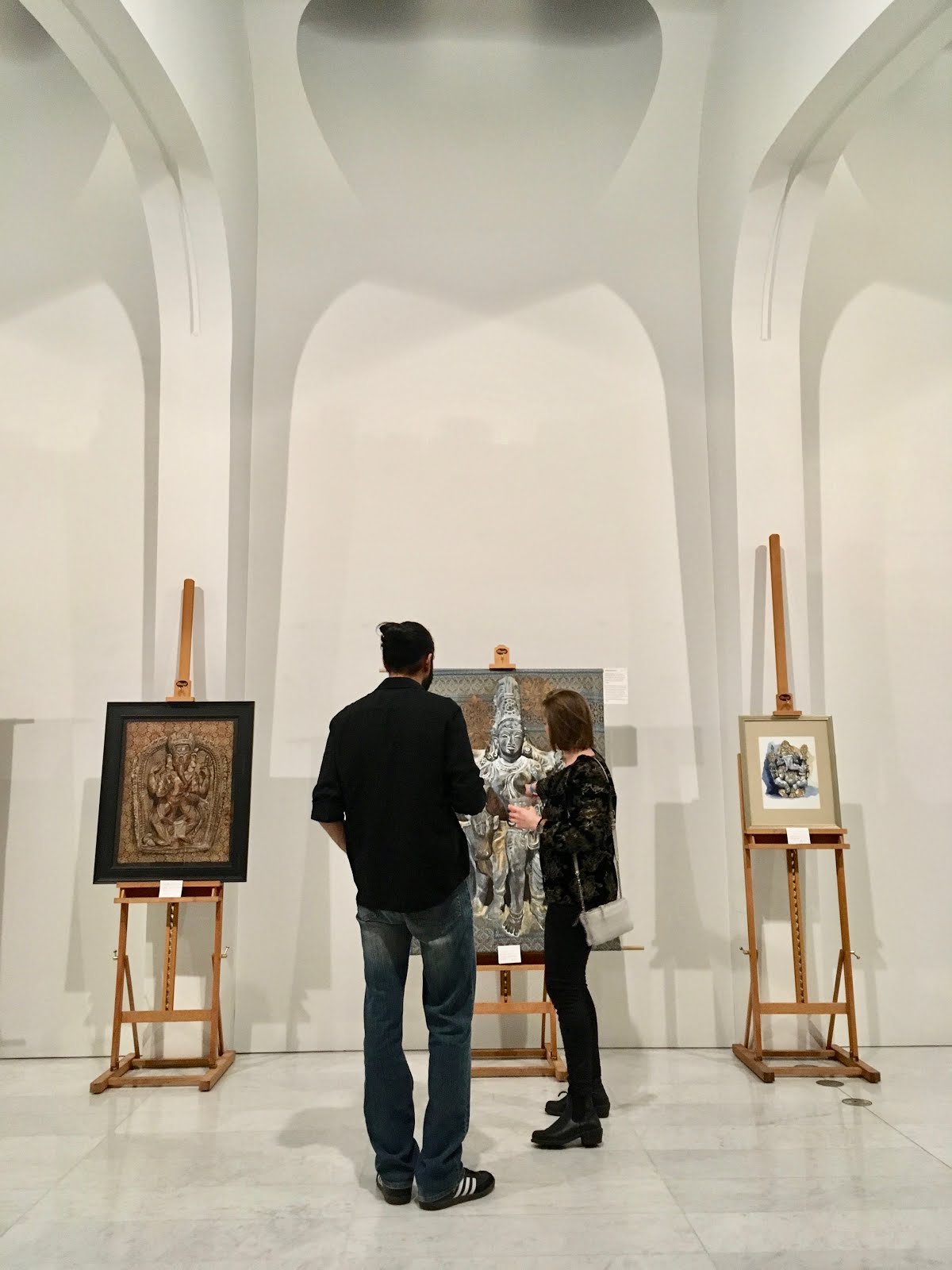
Last evening, May 17, 2019, eight of my large paintings and a handful of smaller works were on exhibit in the large Calatrava Gallery during MAM After Dark: Bhangra & Bollywood event.


My painting, Dancing Ganesha, a popular photo backdrop.


The fun Bollywood-themed event was filled with lively music, lots of energy, and plenty of dancing. The talented dancers from Aarabhi Indian Dance School and Aishwarya Yalamarty & Indian Classical Dances performed everything from Bhangra folk to contemporary Bollywood dances. 


The magnificent Calatrava lit up as the dance floor


Videos of people posing with my painting projected throughout the building.


Attendees could tour the art museum, sample South Asian food, get henna tattoos, create several of their own craft projects, and so much more. I had a great time being there to discuss my work with people and meeting with several of my old students from University of Wisconsin-Milwaukee.


My artworks on display in the long Calatrava Gallery 


Don't forget to check out my artwork available at my Etsy store, Facebook page, as well as my Instagram feed.

Wednesday, April 17, 2019

Pearls of Wisdom from the Himalayas

I've recently completed a new large diptych inspired by Bhutanese architectural sites I have visited. A few months ago, I posted about a watercolor I had done while experimenting with this idea.

Winds carrying the Three Jewels is a common decorative element on buildings in Bhutan. Several stylized motifs representing the winds have been incorporated in the painting below.


Pearls of Wisdom II
36 x 48 inches
acrylic on Kalamkari fabric


Motivated by a desire to reintroduce bright colors into my painting, I am studying the vibrantly painted Buddhist symbols that decorate Himalayan temples and monasteries. A particularly brilliant blue hue on the doorway pictured below was unlike any I have experienced.  I have attempted to contrast this blue against the very warm colored fabric surface.


A simple circular dharma wheel appears in both panels of the diptych. The golden rims of the wheels enclose "swirls of joy" that spiral outward like a Chinese yin-yang symbol. The four colors swirling together correspond to the four directions and elements, and symbolize the Buddha’s teachings upon the Four Noble Truths. 


Pearls of Wisdom I
36 x 48 inches
acrylic on Kalamkari fabric


The Four Noble Truths contain the essence of the Buddha's teachings.
  1. The truth of suffering (Dukkha)
  2. The truth of the origin of suffering (Samudaya)
  3. The truth of the cessation of suffering (Nirodha)
  4. The truth of the path to the cessation of suffering (Marga)
The Four Noble Truths were presented by the Buddha in the first sermon at Deer Park and are considered one of the most important teachings.

On Christmas Day 2017, I made the pilgrimage to Deer Park in Sarnath, India where the Buddha taught his first taught sermon, the "Dhamma Chakka Pavattana Sutta." The name of this teaching means, "Setting the Wheel of Dhamma in Motion." 


The massive Dhamek Stupa in Sarnath marks the spot where the Buddha gave that first sermon to his first five brahmin disciples.


Some of the intricate sandstone carvings decorating the stupa remain.


The banding of patterns on this block-printed Kalamkari fabric reminded me of the sandstone carvings on the Dhamek Stupa. 


The wide black horizontal and vertical bands on the fabric also reminded me of the black beams on the Bhutanese structure pictured below.


A row of giant white circles on a black beam is startlingly bold in contrast to the ornate geometric designs and complex pastel floral elements on the same facade. These circles may represent the moon. Another row of smaller white circles (or pearls) on an orange background relate to the "flaming pearl", a symbol of wisdom and spiritual awareness. "Pearls" like these are a featured element in my diptych. 


On the lintel shown below, a chrysanthemum motif encloses a pearl and is surrounded by spiraling gusts of wind. Winds carrying the Three Jewels appear on the capitol of the column which is topped with a row of flaming pearls surrounded by golden rings.


Here are links to a few of the informative articles I have been reading about Buddhist Symbolism: